Gentle, printable tools to help you understand what is happening within you, meet yourself with compassion and choose a next step that feels possible in real life.
You do not need to complete them all. Choose the guide that feels closest to what you need today.
Choose your guide
Start where you are today
Each guide explains why the reflection may help and what you will be invited to do before you download it.
Support withRelationships & communication3 guides
01Empathy and repair
Through Their Eyes
Why this may helpSometimes our actions affect people in ways we did not intend. This guide helps you slow the moment down, understand another person’s point of view and respond with care rather than shame.
What you’ll doYou’ll reflect on what happened, consider what the other person may have felt, imagine how the experience might have felt for you and choose one thing you could do differently next time.
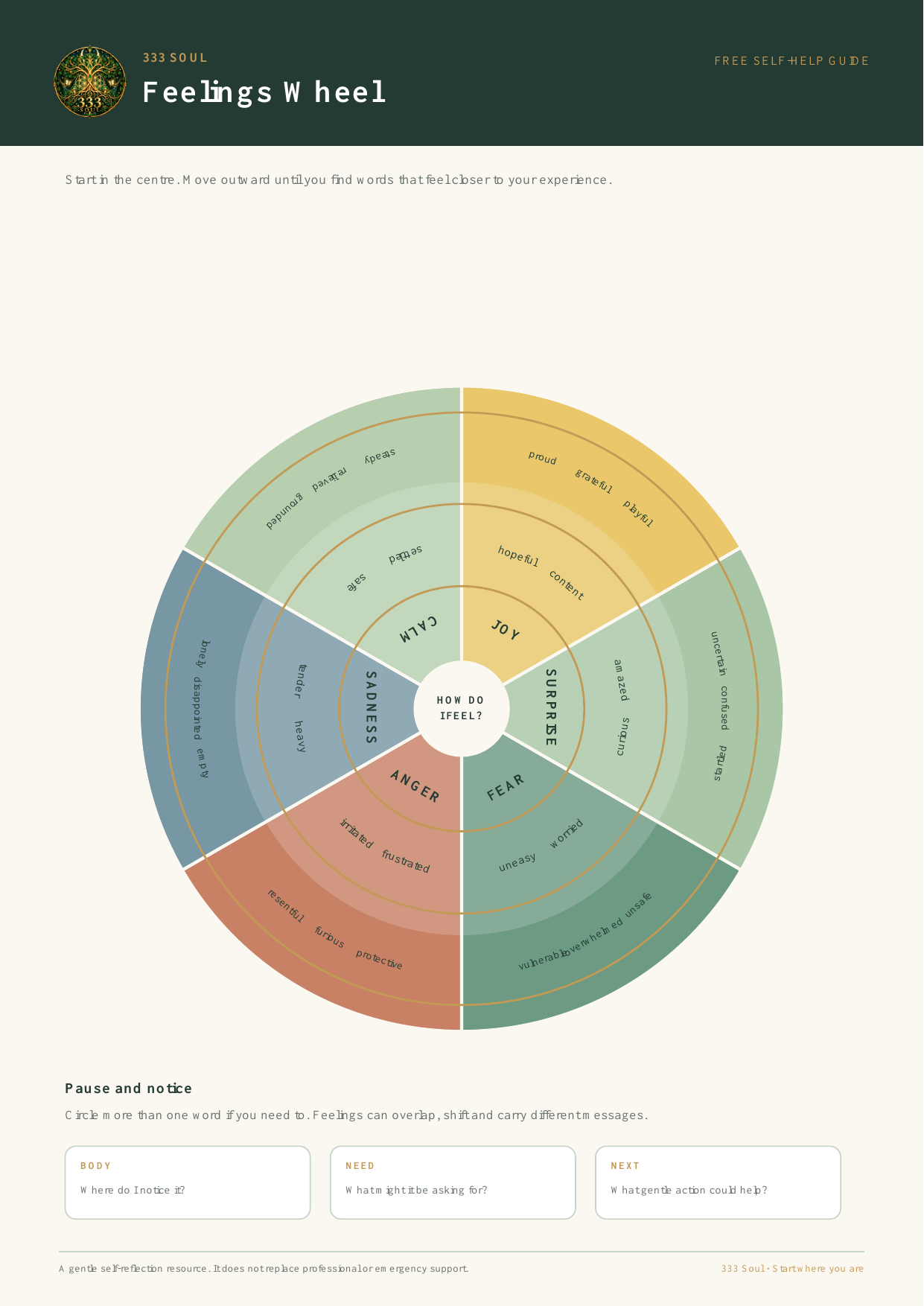
Why this may helpFeelings can be difficult to name, especially when several are present at once. The wheel helps you move beyond ‘fine’, ‘bad’ or ‘upset’ and find words that fit your experience more closely.
What you’ll doBegin with the core feeling nearest the centre, then move outwards towards more specific words. Use the word you find as a starting point for journalling, conversation or simply noticing what you need.
Why this may helpEmotions are not fixed labels; they move, change intensity and often carry useful information. This guide helps you notice the shades between basic feeling words.
What you’ll doYou’ll locate the feeling that is closest to your experience, explore its intensity and notice any neighbouring emotions. Use what you find to consider the need or message beneath it.
Why this may helpEvery feeling is valid, while the way it is expressed can still affect us and others. This diary supports accountability without shame.
What you’ll doYou’ll track the feeling, expression, response, unmet need and what you may want to try next time.
Why this may helpValues are the qualities and directions that matter deeply to you. Reconnecting with them can bring a sense of purpose when life feels noisy, uncertain or pulled in too many directions.
What you’ll doYou’ll choose one value that matters to you and turn it into three small, realistic actions you can take. The finished page becomes a gentle map back to what matters.
Why this may helpGoals are more helpful when they fit your real life rather than becoming another way to measure yourself. This guide turns hopes into clear, manageable direction.
What you’ll doYou’ll describe what you want in the near and longer term, identify possible obstacles and strengths, and choose one action you can begin without waiting for perfect conditions.
Why this may helpNeeds do not arrive in a perfect order. This flexible map helps you notice what is asking for care without judging where you should be.
What you’ll doYou’ll reflect on body, safety, connection, worth and growth, then choose one need to support gently now.
Why this may helpGrowth does not require pretending something is easy. It means you can develop responses, skills and support without being defined by one chapter.
What you’ll doYou’ll name the real difficulty, identify what can develop and choose a realistic next experiment.
Why this may helpStress can narrow our thinking until one painful interpretation feels like the whole truth. This guide helps you create space for a more balanced view without denying what is difficult.
What you’ll doYou’ll try six gentle reframing approaches: examining the evidence, seeing the bigger picture, finding what is still possible, speaking to yourself as a friend, adding perspective and looking beyond the problem.
Why this may helpAvoidance can bring short-term relief, but it can also make fear feel larger and keep life smaller. This guide supports you to approach safe fears gradually and compassionately.
What you’ll doYou’ll name the fear, notice the ‘what if’ thoughts that encourage avoidance, explore what could go right and plan one small, supported step forward.
Why this may helpWorry often asks us to solve things that are outside our control. Separating what you can influence from what you cannot can help you use your energy with greater care.
What you’ll doYou’ll name the situation, place what you can control inside the circle and what you cannot control outside it, then choose one meaningful action and one thing to begin releasing.
Why this may helpWhat happens to us matters, but the meaning our mind gives an event also shapes how we feel and respond. Seeing the cycle makes room for awareness and choice.
What you’ll doYou’ll follow a situation through thought, emotion and behaviour, then explore whether another believable interpretation might create a different response.
Why this may helpA thought log helps you notice triggers and recurring patterns without treating every thought as a fact. Over time, it can reveal where a gentler or more accurate response is possible.
What you’ll doFor each moment, you’ll record the situation, the thought that appeared, your emotional or behavioural response and what happened afterwards.
Why this may helpUnwanted thoughts can feel frightening, especially when they clash with your values. This guide helps separate a thought from intention, identity and action.
What you’ll doYou’ll label the thought with compassion, notice what it touches and practise returning your attention to what matters now.
Why this may helpA thought can feel completely true while still being only one interpretation. Gentle questions can loosen certainty without forcing positivity.
What you’ll doYou’ll look at evidence, possibility, past influence and other viewpoints before writing a fairer, more useful thought.
Why this may helpThe inner critic often believes harshness will keep us safe or help us improve. In reality, it can drain confidence and make it harder to recover from mistakes.
What you’ll doYou’ll write down what your critic says, notice the fear or useful message beneath it, and translate those words into the honest but encouraging voice of an inner coach.
Why this may helpThe strengths you use every day can become almost invisible to you. Taking time to recognise them can support confidence, self-respect and a fuller view of who you are.
What you’ll doYou’ll reflect on abilities, compliments, qualities, values, challenges you have overcome, ways you have helped others and the things that make you uniquely you.
Why this may helpRecognising stress early gives you more choice about how to respond. Your body, emotions and behaviour often signal overload before your mind has found the words for it.
What you’ll doYou’ll list your physical, emotional and behavioural signs of stress, circle the ones that affect you most and identify things that can help settle your system.
Why this may helpVulnerable moments are easier to navigate when you have already made a compassionate plan. Preparation is not expecting failure; it is choosing support before you need it.
What you’ll doYou’ll identify your warning signs, people you can contact, grounding or distracting activities and the next caring steps to take if an urge or old coping pattern returns.
These resources support reflection and conversation; they are not a replacement for therapy, medical care or emergency help. Choose what feels useful, pause when you need to, and come back another day.